
Compare Creality 3D K1C vs Creality 3D Ender 5 Plus
Comparison between the best 3D printers
Choose the best 3D printer at the best price. The cheapest 3D printers are here.
Buy a 3D printer here with 3D Fila.
 |
 |
|
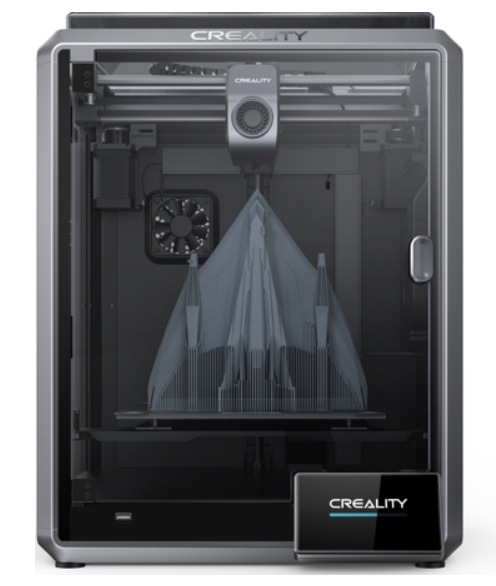
| Model | Creality 3D K1C[BUY K1C] |
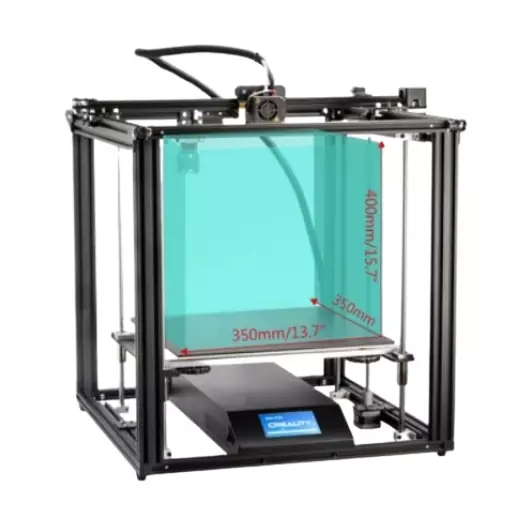
Creality 3D Ender 5 Plus[BUY Ender 5 Plus] |
| Printing Material | Filament | Filament |
| Estimated price | $449,00 | $599,00 |
| Date of registration in the system | ||
| Manufacturer | Creality 3D | Creality 3D |
| Release Year | 2024 | 2019 |
| Print Volume [mm] | 220x220x250 | 350x350x400 |
| Printer Size [mm] | 355x355x480 | 632x619x666 |
| Weight [kg] | 12,4 | 18,2 |
| Power Loss Recovery | YES | YES |
| Enclosed printer | YES | NO |
| Bed Leveling | Automatic | Automatic |
| Filament End Sensor | YES | YES |
| Bed type | Heated | Heated |
| Power supply system | Direct Drive | Bowden |
| Standard nozzle | 0,4 | 0,4 |
| Maximum Nozzle Temperature [°C] | 300 | 260 |
| Maximum Bed Temperature [°C] | 120 | 100 |
| Maximum printing speed [mm/s] | 600 | 180 |
| Filament holder | YES | YES |
| Camera for supervision | YES | NO |
| Recommended filaments | ABS, PLA, PETG, PET, TPU, PA, ABS, ASA, PC, PLA-CF, PA-CF, PET-CF | PLA, TPU, ABS, PETG |
| Recommended slicers | Creality Print; Cura, Simplify3D e PrusaSlicer | Cura, Simplify, Slic3r |
| Maximum Resolution [mm] | 0,1 | 0,1 |
| Kinematics | - | - |
| Extruder Type | - | - |
| Klipper Firmware | NO | NO |
| Input Shaping | NO | NO |
| Max Volumetric Flow [mm³/s] | - | - |
| Power Supply | 110/220V / 350W | 24V / 504W |
| Connectivity | Ethernet / USB / Wi-Fi | SD / USB |
| Release date | 2024 | 2019 |
| Extra features | The Creality K1C is a fully enclosed CoreXY 3D printer featuring an all-metal extruder, tri-metal âUnicornâ nozzle for abrasive materials, automatic bed leveling with nozzle cleaning, AI-assisted failure detection, built-in camera for timelapse, enhanced cooling system, root access to Klipper firmware, and compatibility with PLA-CF, PA-CF, PET-CF, TPU, ABS, and more. | The Ender 5 Plus offers a large print volume (350x350x400 mm) and fast assembly. It includes a BLTouch sensor, but with range limitations. It stands out for its dimensional accuracy, although it requires adjustments to the slicer settings. Despite the noise, its integrated design saves space, and includes features such as a filament sensor and power resumption. Ideal for large projects, it requires refinement in the settings for high-quality prints. |
| Support for multiple colors and materials (AMS and CFS) | NO | NO |
Notes * |
||
| Cost-benefit | 8 / 10 | 7 / 10 |
| Hardware | 4.8 / 10 | 2 / 10 |
| Screen | . | . |
| Print volume | 10 / 10 | 10 / 10 |
| Performance | 10 / 10 | 7 / 10 |
| [BUY K1C] | [BUY Ender 5 Plus] |
Conclusion |
Conclusion: Comparative Review of K1C and Ender 5 Plus 3D Printers When selecting a 3D printer, it is essential to consider the specific needs and expectations of the user. The Creality K1C and Ender 5 Plus are two compelling options, each with distinct advantages and drawbacks. Below is a detailed comparison of both models, focusing on their features, pros, and cons. K1C (Creality 3D)
Pros:
Cons:
Ender 5 Plus (Creality 3D)
Pros:
Cons:
Final Verdict: Choosing the best 3D printer ultimately depends on the user's specific needs. If you are a hobbyist or a professional looking to print high-quality models quickly and with a variety of materials, the K1C would be the better choice due to its advanced features, speed, and enclosed design. It is particularly well-suited for users who require reliability and efficiency in their prints. On the other hand, if you are focused on larger projects and have the patience to refine settings for optimal results, the Ender 5 Plus offers a substantial build volume and is an excellent choice for those who prioritize size over speed. It is ideal for users who do not mind spending additional time on adjustments and are comfortable with a more hands-on approach to 3D printing. In conclusion, for speed and advanced features, go with the K1C; for larger projects and a more traditional approach, the Ender 5 Plus is the way to go. |